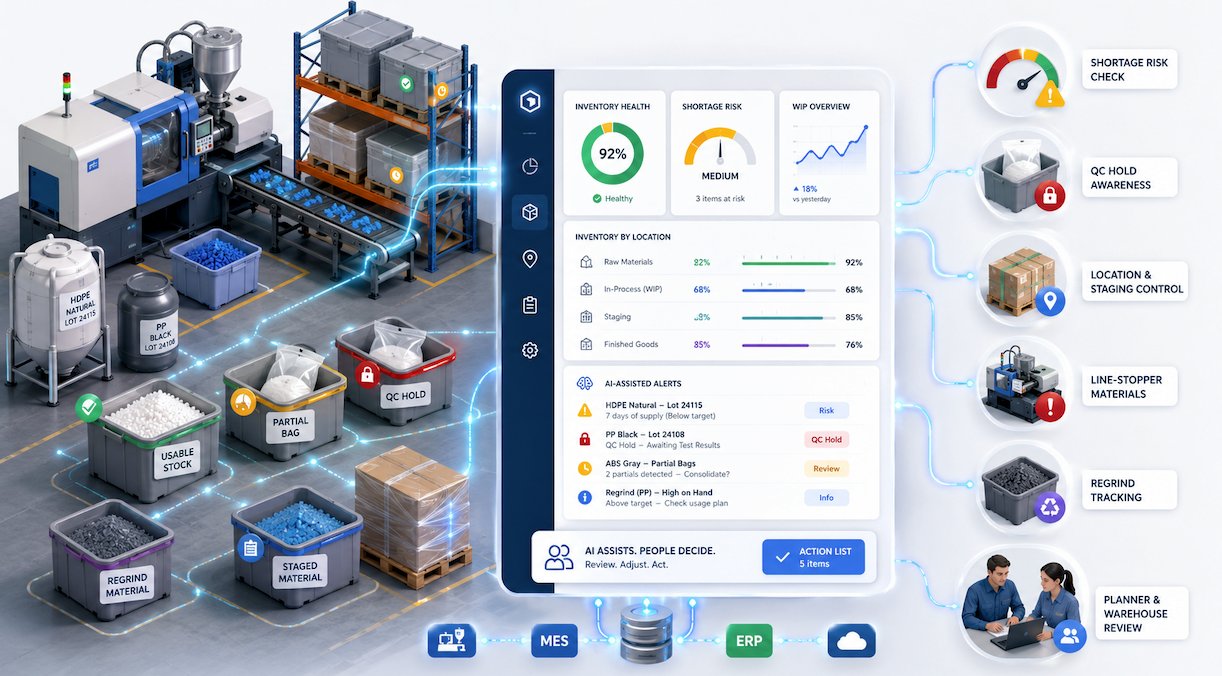
Small manufacturers often feel inventory problems before they see them. A resin shortage shows up as an unplanned changeover, a missed ship date, or an overtime weekend. On the other side, too much stock quietly ties up cash and space, and it increases the odds of obsolescence, contamination, or mispicks.
In polymer and plastics operations, inventory control is harder because the material rules are different. Lot traceability, moisture sensitivity, regrind percentages, color change scrap, shelf life for additives, and packaging constraints all affect what is actually usable on the floor.
This post lays out a practical way to streamline inventory management without a massive system overhaul. The lesson is simple: get the few decisions that drive 80 percent of the inventory outcomes under control, then automate the routine checks in a way your team can trust.
Why Inventory Control Matters in Plastics and Polymer Plants
Inventory is not just a finance topic. It is production stability.
Common plant-level pain points tied to weak inventory discipline include:
- Short-notice material expedites and premium freight
- Schedule changes caused by missing resin lots, masterbatch, inserts, labels, or packaging
- Excess WIP that hides quality issues and makes counting unreliable
- Regrind and scrap that are recorded late, or not recorded, so planning is working from the wrong truth
- Lot traceability gaps that create risk during customer complaints or audits
In plastics operations specifically, “inventory available” is often not the same as “inventory usable.” For example:
- A resin lot may be physically present, but it is not dried, not staged, or not approved by QC.
- A colorant may be on hand, but the remaining quantity is in partial bags and not accurately recorded.
- Regrind may exist, but the allowed percentage varies by part, customer, or specification.
Where to Focus First: A Practical Decision Framework
If you try to fix everything at once, you will likely end up adding admin work without improving availability. Use this quick framework to decide where to focus.
Step 1: Classify Items by How They Hurt You
Sort materials into three groups based on operational impact:
- Line-stoppers: resin, critical additives, packaging, inserts, labels, molds, or tooling components that halt production when missing.
- Yield drivers: colorants, regrind, purge compounds, and drying consumables that heavily influence scrap and changeover loss.
- Cost traps: slow movers, customer-specific packaging, aging lots, and materials with shelf life or contamination risk.
Step 2: Choose the Right Control Method for Each Group
Use tighter controls only where they pay back.
- Line-stoppers: tighter reorder triggers, shorter review cycles, and clear staging rules.
- Yield drivers: better usage capture, actual vs standard tracking, and stronger floor discipline around partials and returns.
- Cost traps: purchasing guardrails, disposition routines, and clear ownership for obsolete stock.
Step 3: Decide What Must Be Real-Time vs Daily vs Weekly
Not everything needs scanning at the machine.
- Real-time, or shift-by-shift: resin issues, line-stopper shortages, material moves to staging, scrap, and regrind generation.
- Daily: cycle count results, adjustments, receiving discrepancies, and QC holds/releases.
- Weekly: slow mover review, obsolescence review, and parameter tuning, such as min-max levels and safety stock.
A Practical Checklist: Inventory Basics That Actually Work for SMEs
Use this checklist to stabilize inventory before you add more technology.
Accuracy and Visibility
- One clearly defined item master per material, with no duplicates for the same resin or color.
- A simple location structure that matches the physical plant, such as warehouse zones, staging, drying area, WIP, and quarantine.
- QC hold and release status is visible to planners and supervisors.
- Partial bags, partial boxes, and opened containers have a standard method for weighing and recording.
Flow and Discipline
- Receiving has a standard for labeling, lot capture, and put-away timing.
- Production staging rules are documented, including what must be staged, where, and when.
- Material returns from the line are recorded the same day, not at month end.
- Regrind is treated like inventory: recorded, labeled, and stored by material family and contamination risk.
Planning and Parameters
- Min-max or reorder points are based on actual lead times, not old assumptions.
- Safety stock rules are clear for line-stoppers, especially imported resins or long-lead packaging.
- Substitution rules are documented, such as approved alternates for resin grades, color matches, and packaging.
Ownership
- One person owns item master hygiene, even if it is part-time.
- One person owns cycle counting and discrepancy follow-up.
- Supervisors own staging compliance on each shift.
Practical Use Cases for an AI-Supported Inventory Routine, Without the Hype
If your ERP or MES data is “good enough,” AI can help as a support layer, not as the boss. The most useful early wins are routine checks that people do inconsistently.
Practical, low-risk use cases include:
- Shortage risk check: compare the next 7 to 14 days of schedule demand to on-hand, on-order, and QC-held inventory, then flag the top risks for review.
- Receiving discrepancy triage: identify POs where receipts do not match expected quantities or lots, then prompt follow-up.
- Slow mover watchlist: surface materials with no usage over a chosen window, plus what customer or job they belong to.
- Regrind balance check: spot when regrind generation and consumption are drifting from normal, which can indicate recording issues or process instability.
- Parameter tuning suggestions: propose min-max changes based on recent lead time, usage volatility, and service level targets, for humans to approve.
The key: the output should be a short list for humans to act on, not a black-box “new plan” that the floor cannot explain.
Practical Example: Injection Molding Shop Managing Resin, Color, and Packaging
Imagine a 25 to 40 press injection molding SME running automotive and appliance parts.
The Problem
- The planner schedules a high-run black part for Monday.
- On paper, resin is available.
- On the floor, two resin lots are in QC hold, one pallet is staged for a different press, and the only available black masterbatch is partial bags not recorded accurately.
- The team swaps jobs, burns time on changeovers, and ships late.
A Streamlined Approach
- The team creates line-stopper rules: resin, masterbatch, inserts, and packaging must be verified as usable by Friday for Monday starts.
- Locations are simplified: warehouse, drying, staging, WIP, and quarantine.
- Partial bags are weighed at return-to-stock with a simple scale and a standard label.
- Regrind is stored by resin family with contamination rules and recorded daily.
What an AI-Assisted Check Could Do, With Human Approval
- Every afternoon, it flags Monday jobs where any line-stopper is short, on hold, or in the wrong location.
- It highlights materials with “on hand but not usable” status, such as quarantine, QC hold, not dried, or not staged.
- It generates a short action list for the planner and warehouse lead: move, dry, substitute if allowed, or expedite.
This does not replace the planner. It reduces surprises and forces the right conversations before the line is waiting.
Guardrails to Keep Humans in Control, Especially with AI, ERP, and MES Data
Inventory touches quality, traceability, and customer commitments. If you use AI to support decisions, add guardrails from day one.
Recommended guardrails:
- Human approval required: for any purchase recommendation, substitution, or parameter change.
- Traceability protected: never suggest mixing lots or using alternates unless approved rules exist.
- QC status respected: anything on hold stays on hold, no exceptions.
- Clear reason codes: every suggestion should show the “why” in plain language, such as demand spike, lead time drift, or frequent shortages.
- Audit trail: log what was suggested, what was accepted, and what was overridden.
- No auto-adjustments: do not automatically adjust inventory quantities, only prompt investigation and controlled corrections.
If the underlying data is unreliable, do not automate decisions. Start by automating detection of data problems.
A Practical First Step: 2-Week Pilot Plan
You can test improvement quickly without boiling the ocean.
Week 1: Stabilize the Basics
- Pick 10 to 20 line-stopper items, such as resin, masterbatch, packaging, and inserts.
- Confirm item master, locations, and QC status workflow.
- Run a focused cycle count on those items and fix root causes of discrepancies.
- Document staging rules for the next week’s schedule.
Week 2: Add a Simple Daily Risk Review
- Create a daily shortage risk meeting, 15 minutes, with planner, warehouse, and a production lead.
- Review only the top 5 risks and assign actions.
- Track shortages prevented, schedule changes avoided, and the reasons behind each risk.
Once this rhythm works, then it is worth adding an AI-supported “risk list” that pulls the signals automatically.
Closing: Make Inventory Boring, Predictable, and Usable
Streamlined inventory management is not about perfect accuracy everywhere. It is about making sure the materials that control uptime, quality, and ship dates are visible, usable, and managed with discipline.
If you want help tightening inventory control in a plastics or polymer operation, UP Manufacturing AI can help you set up a practical inventory routine and add an AI-assisted risk check that keeps humans in control.