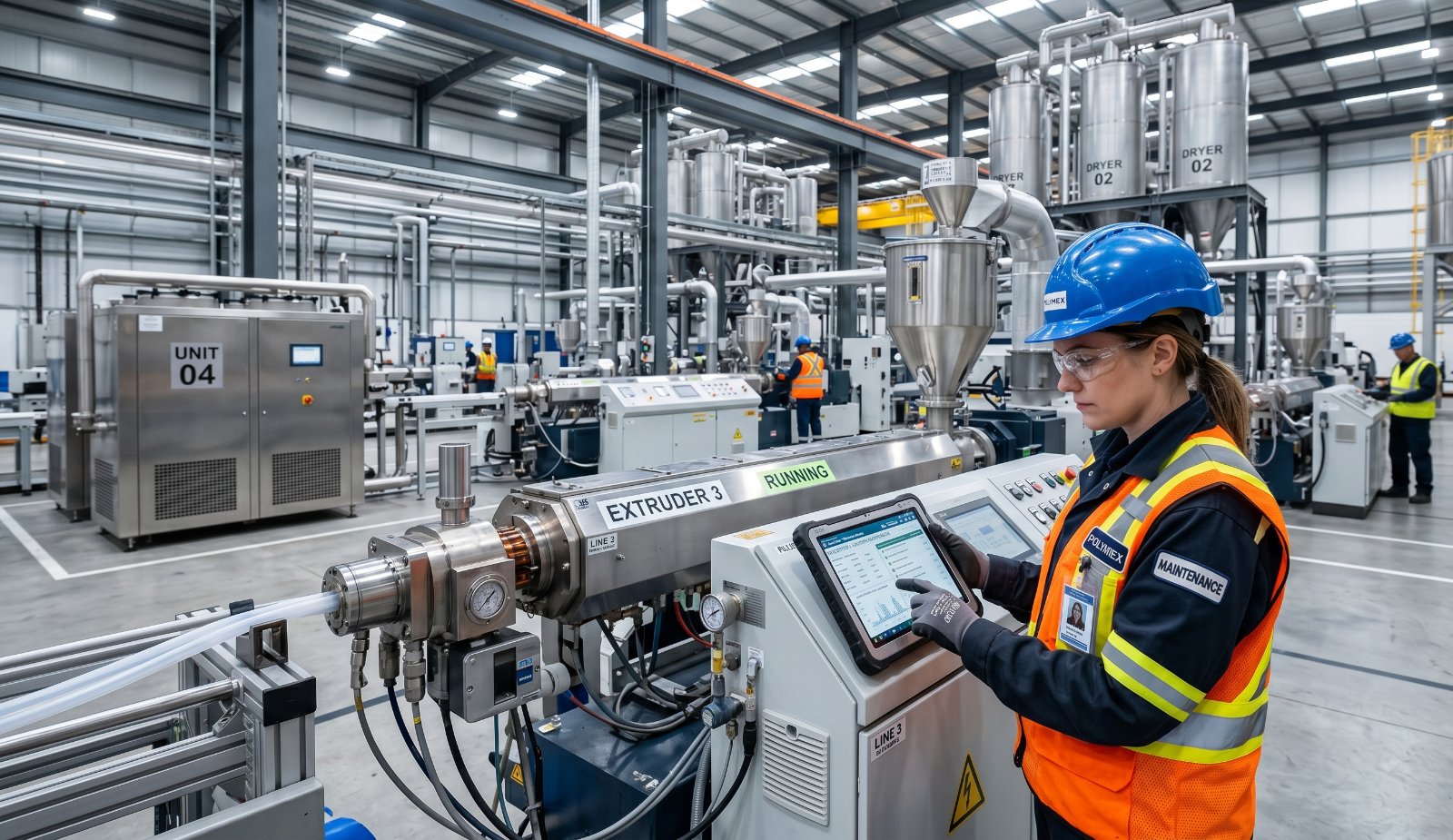
Polymer processing lines are sensitive to small equipment issues. A worn screw, a drifting heater band, or a sticking valve can show up as scrap, short shots, burn marks, gels, or unstable cycle times before the machine actually fails.
This post is a practical guide to maintenance improvements that help polymer processing stay stable. It is written for maintenance managers and plant leaders in SMEs who need clear actions, not generic advice.
Start with the “polymer-critical” equipment list
Not every asset needs the same maintenance depth. In plastics operations, a short list usually drives most quality issues and downtime.
Typical polymer-critical assets include
- Extruders: barrel and screw condition, gearbox, motor, drive, feeders, melt pump (if used)
- Injection molding machines: screw and barrel, check ring, hydraulic system, clamp mechanism, nozzle, hot runner controllers
- Dryers and material handling: desiccant dryers, dew point sensors, vacuum pumps, loaders, filters, hoses
- Cooling systems: chillers, cooling towers, mold temperature controllers, water manifolds, strainers
- Hot runner and heating: heater bands, thermocouples, connectors, temperature controllers
Action: Create an “A list” of assets that can stop the line or cause major quality drift. Keep it short. If everything is critical, nothing is.
Align maintenance tasks to common polymer failure modes
A good PM plan is not “monthly lubrication and a checklist”. It targets the real failure modes that show up in polymer processing.
Examples of failure modes and the maintenance tasks that actually help
- Moisture related defects (splay, bubbles, brittle parts): verify dryer dew point sensors, check dryer airflow, inspect desiccant condition, check hopper seals and pickup hose leaks
- Temperature drift (burn marks, haze, unstable melt): inspect heater band wiring and connectors, verify thermocouple placement, tighten terminal connections, confirm controller calibration checks are scheduled
- Contamination (black specks, gels, streaks): inspect material handling lines, loader filters, vacuum pump filters, hopper magnets (if used), implement cleaning standards with documented frequency
- Shot size or extrusion rate instability: check screw wear indicators, check valve sealing or check ring condition, confirm feeder calibration checks, inspect melt pump coupling (if applicable)
- Cooling issues (warpage, long cycle times): clean strainers, verify flow rates, descale heat exchangers, check mold temperature controller performance
Action: Rewrite PM tasks in plain language that points to a defect or downtime risk. If a technician cannot tell what problem the task prevents, the task usually gets skipped or done mechanically without value.
Use “quality signals” as early maintenance triggers
In polymer processing, quality often tells you maintenance is overdue.
Common early signals
- Gradual increase in reject rate for one cavity, one mold, or one machine
- Cycle time creeping up by 1 to 3 seconds over a shift
- More frequent purging, more frequent filter changes, more screen pack changes
- Dryer alarms, dew point trending worse, or material “stringing” and inconsistent feed
- Operators compensating by raising temperatures, boosting back pressure, or adjusting injection speed more often than usual
Action: Add a simple rule. If a process parameter has been adjusted more than a defined number of times per shift to hold quality, create a maintenance follow-up work order. This stops small drift from becoming a breakdown or a week of scrap.
Make lubrication, tightening, and cleaning standards specific
Many breakdowns come from basics that were done inconsistently.
What “specific” looks like
- “Clean loader filter” becomes “Clean loader filter, confirm vacuum level returns to normal range, record before and after reading.”
- “Check cooling” becomes “Inspect strainer, record differential pressure or visual clog level, flush if above limit.”
- “Inspect heaters” becomes “Inspect heater bands for hot spots and loose connections, confirm temperature stability within a defined range after warm-up.”
Action: Update the PM instructions so two different technicians will do the task the same way. Include what to measure and what ‘good’ looks like.
Tighten planning, kitting, and downtime windows
Even great PM tasks fail when the job is not planned well.
Practical improvements for SMEs
- Create a small “polymer spares” kit list for each line (heater bands, thermocouples, common fittings, filters, dryer seals, vacuum hose, screen packs where applicable)
- Reserve a repeating weekly downtime window for inspections that cannot be done while running
- Pre-stage tools and lockout requirements in the work order, so techs are not searching or waiting
Action: For each critical asset, define the top 10 spares that cause the most delay when missing. Stock those first. Do not try to stock everything.
Add light condition checks, not expensive systems
You do not need a full sensor overhaul to get condition-based benefits.
Low-effort checks that work in plastics plants
- Dew point verification checks on dryers, plus a routine to inspect leaks in pickup lines
- Simple infrared temperature checks on heater band zones and electrical panels
- Vibration or noise checks on vacuum pumps, gearboxes, and motors (even a consistent “listen and record” routine helps)
- Cooling flow checks, plus routine strainer inspection
Action: Pick one condition check per major system and make it repeatable. Track it. Trend it. Use it to decide what to fix before it fails.
Close the loop with disciplined follow-up
Most maintenance programs struggle in the same place: follow-up. Findings are noted, but not turned into scheduled work. Or parts are needed, and the job disappears.
A practical follow-up routine
- Every inspection work order must end with one of three outcomes: “No issue”, “Monitor”, or “Repair needed”
- If “Repair needed”, it must generate a planned corrective work order with parts list and target date
- If “Monitor”, assign a next check date and define what threshold triggers repair
Where AI can help (without hype)
A simple maintenance follow-up agent can read technician notes, identify missing fields (parts, asset, symptom, recommended action), and prompt for completion. It can also suggest a standardized failure code based on the text, so your history becomes searchable and useful.
Action: Look at your last 30 inspection work orders. How many have clear next steps and a scheduled follow-up? Fix that first, before buying new tools.
Polymer-specific examples of “advanced maintenance” in practice
Advanced maintenance does not have to mean complicated.
Example A: Dryer performance drift
- Symptom: more splay, more brittle parts, operators raise melt temperature to compensate
- Maintenance trigger: dew point trending worse, or dryer alarms increasing
- Solution: inspect desiccant, check regeneration cycle, verify airflow, test for pickup hose leaks, calibrate or verify dew point sensor
- Follow-up: record dew point, set a recheck date, and capture the root cause in the CMMS notes
Example B: Hot runner instability
- Symptom: intermittent shorts, burned connectors, temperature overshoot
- Maintenance trigger: increasing controller alarms or repeated zone adjustments
- Solution: inspect connectors, strain relief, thermocouple seating, tighten terminals, replace damaged cables, verify stable readings after warm-up
- Follow-up: standardized note format, list replaced parts, and schedule a re-torque check
Example C: Cooling restrictions causing warpage and longer cycle time
- Symptom: cycle time increases, parts warp, mold temperature becomes hard to control
- Maintenance trigger: temperature controller working harder, or pressure drop across strainers increases
- Solution: clean strainers, flush circuits, descale heat exchanger if needed, verify flow
- Follow-up: record flow and temperature differential, set the next inspection based on results
Practical next steps for maintenance managers
If you want to improve polymer processing stability in the next 30 days:
- Identify your polymer-critical asset list (top 10 to 20).
- Update PM tasks for those assets to match real failure modes.
- Add two quality triggers that automatically create maintenance follow-up.
- Standardize inspection outcomes (No issue, Monitor, Repair needed) and enforce follow-up work orders.
If you want help setting up the follow-up routine and making technician notes usable, UP Manufacturing AI can support this with a Maintenance Follow-Up Agent and a scheduling workflow that fits how SMEs actually run.